
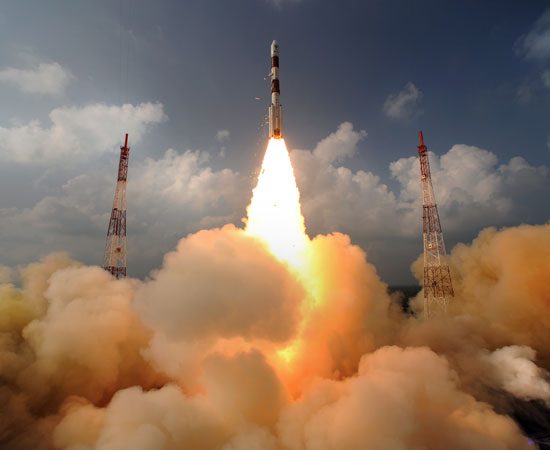
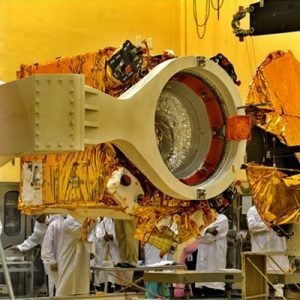
India’s Mars Orbiter Mission successfully entered Mars’ orbit Wednesday morning,becoming the first nation to disembark on its foremost endeavor and the first Asian country to arrive at the Red Planet “We have gone beyond the boundaries of human enterprise and human imagination,” declared India’s Prime Minister Narendra Modi, who watched from the space agency’s nerve center in Bangalore. “We have accurately navigated our spacecraft through a route known to a very few.” The staff at the Indian Space Research Organizations erupted into ovation and cheers subsequent to learning that the Mars Orbiter Mission, also known as Mangalyaan, arrived at the planet’s orbit and made history. Before Wednesday, only the United States, Europe and the Soviets have successfully sent spacecraft to Mars.
“The odds were stacked against us,” Modi said. “Of the 51 missions attempted so far, a mere 21 had succeeded. But we have prevailed.” And India reached Mars with considerably less money. With a price tag of $74 million, the Mars Orbiter Mission cost a mere fraction of the $671 million NASA spent on its MAVEN spacecraft, which arrived to Mars previously this week. A few space observers noted that India’s Mars orbiter cost less than the $100 million budget for the space thriller film “Gravity.”
Discovering Mars from Viking to MAVEN
“It shows how optimal is the design, that way we’re able to cut cost and we’re not compromising quality,” said S. Satish, a space expert based in Bangalore.
The revolutionary Mars mission wasn’t devoid of hullabaloo with various critics who said India should spend the money on other issues. The spacecraft launched on November 5, and has traveled over 650 million kilometers to enter Mars orbit. Its task is to orbit the Red Planet, recording its surface and study the atmosphere. The Mars Orbiter kicked off its interplanetary first appearance with its own Twitter account. The mission has been freighted with nationalistic connotation for India since its beginning and is seen as a figurative coup d’état over its rival, China, which is also ramping up its space ambitions. China’s joint mission with Russia in 2011, which enclosed the Chinese Mars satellite Yinhuo-1, stalled and ultimately fell back to Earth. Japan’s 1998 effort with the spacecraft
Nozomi was also in vain owing to fuel problems. Once nears Mars’ orbit, India’s spacecraft had to carry out a series of intricate and grave maneuvers. About half of all spacecraft sent on missions to the planet have turned astray, breakdown or crashed. India’s Mars Orbiter Mission is in the company of NASA’s two Mars rovers on the ground, a European orbiter and NASA orbiters including the MAVEN, which has been present since Sunday. The United States has expressed interest in assisting India as their spacecraft collect information about the planet.
Want results like these for your business?
Tell us what you're working on. Our engineers will review it and get back to you.
Keep reading

Google Unscrew New Logo In The Company’s History
Search large says the brand new design will soon be visible across all its products only a month after a primary restructuring of the enterprise gave rise to Alphabet
Read article
Sundar Pichai tapped to run restructured Google within Alphabet
One of Sundar Pichai’s clearest recollections of developing up in Chennai, India, entails deciding upon up the results of a blood experiment for one in all his mothers and fathers. It used to be the early Eighties, and…
Read article
Sony’s Smartband Comes In Modern
When you hear the word “wearable,” there’s a good chance you think of a wristband, probably one that tracks your activity. SmartBand makes sure you never miss a thing by vibrating gently when calls, message…
Read article